
LASER 101
What
is a Laser?
“Laser”
is an acronym for Light Amplification by Stimulated Emission of Radiation. Put
more simply, a laser converts energy into light, which is then amplified
through optics, before focusing that light into a high energy beam. Laser light
differs from normal light in that it can be collimated, or made less prone to
dispersion, and then focused to greatly increase its energy density. There are
many kinds of lasers and the uses of laser light include range from
entertainment, scientific endeavors, and surgery, to advanced and heavy duty
industrial manufacturing.
All lasers share a basic set of components. Laser start with a gain medium which is used to amplify the power of light — laser gain mediums include gases, dyes, diodes, crystals, and optical fibers. An energy source, either an electrical current or a source of light, is then used to pump the gain medium. Once the necessary energy is generated reflective materials known as partial and total reflectors control the laser output which is then adjusted and focused as needed for the application at hand.

Laser
Wavelength
Measured
in nanometers (nm) or microns (µm), the wavelength of a laser is the distance
between successive crests of the light wave. Laser wavelengths typically range
from deep ultraviolet to mid-infrared (IR) and are visible to the human eye in
the range from ~400 to ~700 nm.
Wavelength
is a critical consideration for many applications because materials often
differ dramatically in how they absorb the energy of light. Materials absorb
some portion of a laser beam’s energy and reflect the rest — the balance
between the two can necessitate the use of a different laser wavelength.
Wavelength is also of critical importance for advanced and scientific
applications including microscopy, optical trapping, and ultrasonics.
Near
IR wavelengths of approximately 1000 nm are used as a starting point,
particularly for processing of metals. This is because near IR lasers offer
higher powers, are less complex, and are often more cost-effective. Most metals
absorb light in the near IR or visible range efficiently. Even metals with high
IR reflectivity, such as aluminum and copper, are predominantly processed by
near IR lasers which overcome material reflection with higher power densities.
Various polymers, ceramics, glass, and other non-metals are often processed by lasers with wavelengths from mid-infrared to deep ultraviolet. Clear polymers and glass are actually transparent or nearly transparent to near IR light, allowing the majority of near IR light through without being absorbed. As a result, materials that readily absorb near IR light can be processed through a polymer or glass layer.
Laser
Power
Also
referred to as average power, laser power is measured in watts (W). A laser’s
average power represents how much energy is delivered to the target material
over a period of time. Laser power requirements vary by many orders of
magnitude for different applications. Many sensing, data processing, telecom,
medical, or scientific applications utilize powers from a few milliwatts to
tens of watts. Non-metal processing applications typically demand anywhere from
a few watts to a few hundred watts of average power. Metal fabrication
applications demand powers anywhere from hundreds of watts, in the case of some
microprocessing applications, to dozens or more kilowatts, in the case of thick
metal cutting and welding applications.
Laser
Mode of Operation
Lasers
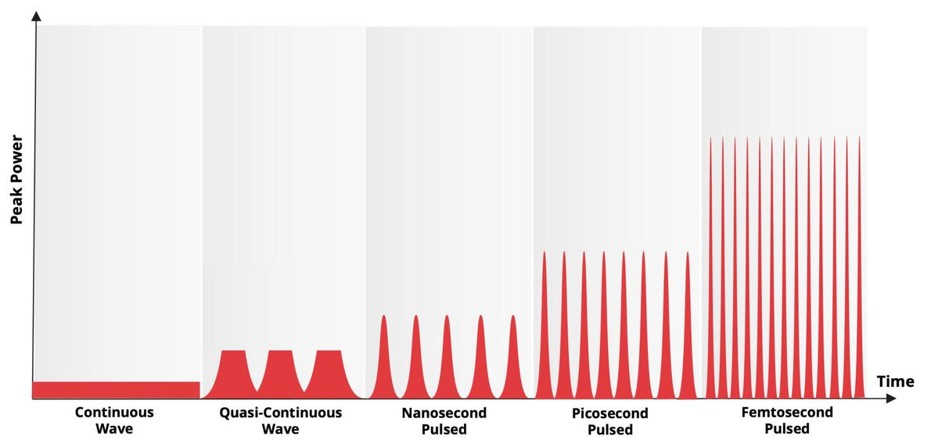
can emit a continuous beam of light to output a steady stream of average power
– this mode is referred to as Continuous Wave (CW) and is the most common laser
mode of operation. Lasers can also be used in a pulsed mode of operation.
Pulsed lasers are characterized by pulses per second (repetition rate), the
total energy of the laser pulse (pulse energy), the highest power achieved by
the pulse (peak power, and the length of each pulse (pulse duration).
Like
CW lasers, pulsed laser output over time is represented as average power.
Pulsed lasers, even when their average power matches that of a CW laser, affect
targeted material differently. Pulsed lasers are often used to process parts
while minimizing the thermal impact on the surrounding material or when higher
peak power is necessary. Long pulse quasi-continuous wave (QCW) lasers utilize
pulses measured in milliseconds with high peak powers to emulate CW laser
processing with less heat input and with a lower power laser. Nanosecond and
ultrafast (picosecond/femtosecond) lasers take advantage of extremely short
pulses for microprocessing applications where excessive heat input is not
acceptable or when extremely high peak powers are required.
Generally
speaking, CW lasers offer the highest average powers and, as a result, the
fastest processing speeds. There are many considerations to be made when
deciding between a CW laser and a pulsed laser, but balancing throughput with
part quality is often the most important. Many applications, such as sheet
metal cutting, benefit from a high-power CW lasers for greatly increased
cutting speeds and have no need for flawless edge quality. When cutting stacks
of ultra-thin foils, however, nanosecond and ultrafast pulsed lasers are
typically used to ensure excellent edge quality and reduce or eliminate negative
heat effects.
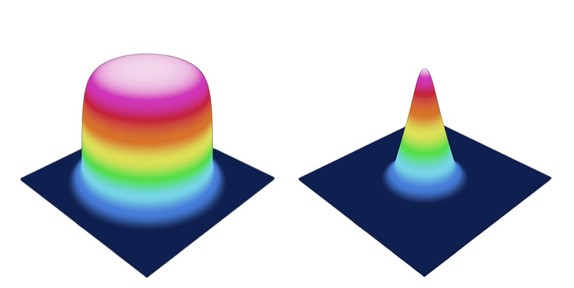
Left: a multi-mode beam profile with a
larger spot size. Right: a single-mode beam profile with a smaller spot size.
Laser
Spot Size & Beam Quality
When a
laser beam comes into contact with its target material it forms an area of
laser light referred to as a spot. Spot size, typically measured in µm, is a
critical factor in determining how a laser interacts with its target. Spot size
can be controlled in a variety of ways, including using different delivery
fibers and focusing lenses, changing the distance between the beam delivery and
the target, and using longer or shorter wavelengths.
Decreasing
the spot size makes more efficient use of a laser’s power by concentrating the
beam’s energy in a smaller area. Higher energy density is useful for increasing
processing speeds by decreasing the time it takes for a laser beam to pierce
the material. Small spot sizes are also essential for a variety of
microprocessing applications and for parts that require fine features. For many
applications like structural welding, however, increasing spot size is optimal
for processing a wider area and reducing the required beam travel.
Beam quality, typically measured in M2 for single-mode lasers (typical spot size: 20 to 50 µm) and Beam Parameter Product (BPP) for multi-mode lasers (typical spot size: 100+ µm), is an important and complex laser parameter that, in practice, represents how much a laser beam can be focused. Lower M2 and BPP values correspond with higher beam qualities. A beam quality of M2 = 1 means that the beam experiences no divergence and is considered perfect. Although this is not quite achievable with actual devices, industrial fiber lasers can reliably achieve beam qualities of M2 =< 1.1. For applications that require strongly focused beams like cutting, drilling, and welding, higher beam qualities improve processing speeds and qualities. Some applications, like wide area laser heat treatment and cleaning, do not require particularly high beam qualities, instead benefitting from less focused laser energy.